Report Irregular Income for SNAP: A 4-Step Guide
Advertisements
Accurately reporting irregular income for SNAP requires documenting household earnings, calculating representative monthly income, completing application forms correctly, and preparing for the verification interview while following applicable federal and state reporting requirements.
Understanding how to report irregular income for SNAP is essential for households seeking food assistance while managing fluctuating earnings from temporary employment, freelance work, or seasonal activities.
Accurate financial information helps state agencies determine eligibility for food assistance benefits, calculate appropriate payment amounts, and identify relevant deductions or other circumstances affecting individual household applications.
This four-step guide explains how to document variable earnings, estimate monthly income, complete application forms, and prepare for verification without making unsupported assumptions about eligibility.
Understanding Irregular Income for SNAP Eligibility
Irregular income refers to earnings that fluctuate in amount, frequency, or timing, making it more difficult for households to establish predictable monthly financial estimates.
The Supplemental Nutrition Assistance Program (SNAP) evaluates relevant household circumstances, including qualifying income, applicable deductions, household composition, and other eligibility requirements established under federal and state regulations.
Understanding irregular income for SNAP helps applicants provide representative financial information while avoiding incomplete records, inaccurate income projections, and misunderstandings concerning individual program requirements.
What Qualifies as Irregular Household Income?
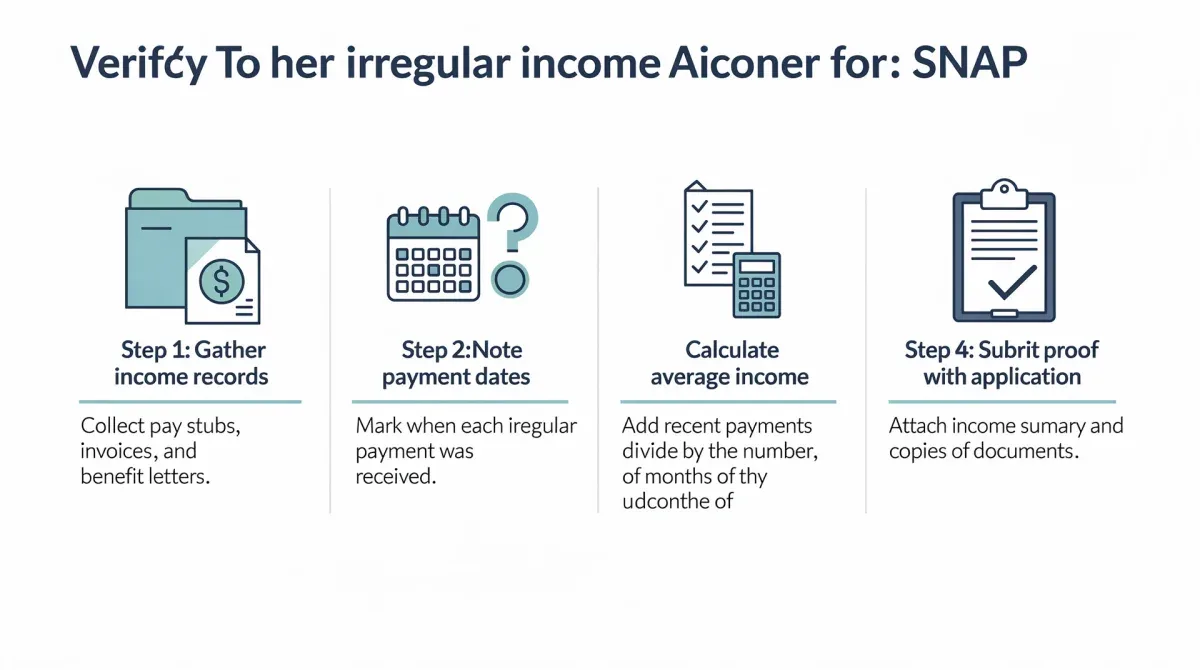
Irregular household income may include fluctuating hourly wages, seasonal employment earnings, commissions, tips, freelance payments, temporary assignments, and compensation received through independent contracting arrangements.
Certain forms of unearned income may also fluctuate, depending on their source, payment schedule, and the circumstances under which household members receive those financial resources.
Applicants should disclose relevant payments as required by their state agency, allowing authorized caseworkers to determine which amounts qualify as countable income or receive alternative treatment.
Understanding Earned and Unearned Income
Earned income generally includes compensation received through employment, self-employment, and other qualifying work activities performed by individuals belonging to the applicable SNAP household.
Unearned income may include unemployment compensation, Social Security benefits, certain support payments, and other financial resources not directly associated with current employment activities.
When documenting irregular income for SNAP, distinguishing earned income from unearned income helps ensure financial records are organized according to the appropriate program classifications.
Understanding Countable and Excluded Income
Federal SNAP regulations establish different treatment for various types of household payments, meaning that not every financial deposit or monetary receipt is necessarily considered countable income.
Certain reimbursements, qualifying educational assistance, loans, infrequent amounts, and other specifically excluded payments may receive different treatment under applicable eligibility regulations.
Applicants should explain the origin and purpose of relevant financial receipts rather than independently excluding payments without confirming how the state agency applies SNAP income rules.
Step 1: Document All Income Sources and Payment Frequencies
The first step in reporting irregular income for SNAP involves creating a comprehensive record of household earnings, payment frequencies, employment arrangements, and other relevant financial resources.
Identify household members who receive income and document applicable payment dates, amounts, sources, and circumstances that may explain variations between individual weeks or months.
Maintaining organized financial records throughout the application period helps applicants provide consistent information and respond appropriately when state agencies request additional verification.
Gathering Essential Financial Records
Collect relevant pay stubs, income statements, employer letters, bank records, client invoices, tax documents, and other materials that may help establish the source and amount of household earnings.
Independent contractors and freelancers may also maintain business records documenting completed assignments, payment dates, outstanding invoices, and allowable expenses associated with generating self-employment income.
Organizing these materials chronologically makes it easier to report irregular income for SNAP and identify differences between individual documents, payment periods, or employment arrangements.
Creating an Income Tracking Spreadsheet
A basic spreadsheet can help households record payment dates, income sources, gross amounts, business expenses, payment frequencies, and relevant notes concerning individual financial transactions.
Separate earnings received from different employers or clients to create a clearer representation of household income and identify which sources contribute to significant monthly fluctuations.
Applicants who prefer handwritten records can use a notebook instead, provided the information remains accurate, complete, consistently updated, and available for requested verification.
Documenting Cash Payments and Tips
Cash payments received through employment, informal work arrangements, freelance services, or tips may represent relevant income even when traditional payroll documentation is unavailable.
Maintain contemporaneous records identifying payment dates, amounts, work performed, and other available information that may help explain the source of individual cash receipts.
When reporting irregular income for SNAP, applicants should ask their state agency which alternative documentation methods are acceptable when formal wage statements cannot reasonably be obtained.
Identifying Income From Multiple Household Members
SNAP household composition does not always include every individual living at the same address because federal rules establish specific requirements for determining household membership.
Applicants should identify individuals belonging to the applicable SNAP household and provide the financial information required for each member under relevant program regulations.
Some household members may receive special income treatment or qualify for specific exclusions, making accurate household descriptions important when determining which earnings must be counted.
Step 2: Calculate Representative Monthly Income From Irregular Sources
After documenting household earnings, the next step involves organizing financial information into an estimate that reasonably reflects expected monthly income during the applicable eligibility period.
Federal SNAP income determination regulations establish procedures for evaluating anticipated earnings, using representative historical income, and accounting for known changes in household financial circumstances.
Calculating irregular income for SNAP requires selecting representative records instead of automatically assuming that every previous payment will recur throughout the future certification period.
Understanding the Previous 30-Day Income Period
Income received during the previous thirty days commonly provides an initial reference for estimating the financial resources expected to become available during the certification period.
However, historical earnings should not automatically be treated as representative when employment conditions have changed or when predictable future circumstances differ substantially from previous months.
Explain recent changes to your state agency so that outdated employment records do not unnecessarily distort the assessment of your household's anticipated financial situation.
Using a Longer Period for Fluctuating Income
When earnings fluctuate substantially, a longer historical period may provide more representative information than financial records covering only the most recent thirty days.
The appropriate verification period depends on employment circumstances, available records, applicable program rules, and whether previous earnings reasonably indicate income expected during the upcoming certification period.
Applicants reporting irregular income for SNAP should work with their state agency to determine an appropriate calculation period rather than selecting whichever period produces the lowest average.
Example 1: Calculating Average Monthly Earnings
Consider a hypothetical worker who receives $900 during one month, $1,500 during the following month, and $1,200 during the third month of a representative earnings period.
Adding these amounts produces total earnings of $3,600, which would equal an illustrative monthly average of $1,200 when divided across the three-month period.
This average may provide a useful reference if the period accurately represents expected future earnings, although the state agency determines the appropriate income calculation method.
Example 2: Converting Weekly Income to Monthly Income
Consider a worker who receives approximately $300 in qualifying weekly earnings and expects this payment pattern to continue consistently throughout the applicable future assessment period.
Using the federal regulation's common weekly conversion factor of 4.3, the illustrative monthly income estimate would equal approximately $1,290 before applicable deductions.
When calculating irregular income for SNAP, households should confirm whether their agency applies this conversion method, an authorized alternative standard, or an exact anticipated monthly amount.
Example 3: Converting Biweekly Income to Monthly Income
A hypothetical employee receiving $600 every two weeks may need to convert those payments into a monthly estimate when completing relevant SNAP income reporting requirements.
Using the common federal biweekly conversion factor of 2.15, these earnings would produce an illustrative monthly income estimate of approximately $1,290.
Actual calculations may differ depending on anticipated payment dates, state conversion standards, qualifying earnings, and the method used by the responsible eligibility agency.
Projecting Future Irregular Income
Future income estimates should be based on reasonable expectations supported by current employment arrangements, known work schedules, representative financial records, and other relevant information.
Explain upcoming seasonal changes, employment termination, reduced working hours, new assignments, and other circumstances that may substantially affect your household's expected income.
When reporting irregular income for SNAP, distinguish reasonably anticipated earnings from speculative payments that cannot yet be reliably estimated or confirmed.
Handling Seasonal Employment and Changing Work Schedules
Seasonal workers may experience significant income differences between active employment periods and months when fewer assignments or employment opportunities are available.
Records from comparable previous seasons may provide useful information, although historical income should not automatically be applied when anticipated working conditions have changed.
Provide available documentation concerning employment schedules, expected work periods, and known interruptions so the state agency can evaluate income under the appropriate program rules.
Understanding Self-Employment and Freelance Income
Self-employment income may require additional documentation because business receipts do not necessarily represent the actual countable earnings associated with an individual's independent work activities.
Individuals reporting irregular income for SNAP through freelance or contracting arrangements should distinguish total business receipts from expenses associated with generating those earnings.
The state agency determines which expenses and calculation methods are allowable under applicable SNAP regulations, making complete business records particularly important for self-employed applicants.
Distinguishing Gross Business Receipts From Net Income
Gross business receipts represent payments received through business activities before subtracting expenses, while net income reflects amounts remaining after relevant business costs are considered.
SNAP self-employment calculations may recognize certain allowable costs associated with producing income, although these deductions do not necessarily match every expense recognized under federal taxation rules.
Applicants should provide accurate records of business revenue and expenses without automatically assuming that their reported taxable income determines their countable SNAP income.
Tracking Business Expenses and Supporting Documentation
Maintain invoices, receipts, business statements, and other materials that document relevant costs associated with providing freelance services or operating an independent business.
Separating personal purchases from business expenses can make financial records easier to interpret and help the agency evaluate which costs receive allowable treatment.
When documenting irregular income for SNAP, ask the responsible agency whether actual expenses, an approved standard, or another applicable calculation method will be used.
Illustrative Self-Employment Income Calculation
Consider a freelancer who receives $2,000 in monthly business payments and documents $500 in expenses directly associated with generating the reported business revenue.
If the state agency recognizes the entire $500 as allowable self-employment costs, the preliminary adjusted business income would equal $1,500 before other applicable SNAP calculations.
This example is illustrative because allowable self-employment expenses, averaging procedures, and subsequent deductions must be determined according to the relevant program requirements.
Step 3: Complete the SNAP Application Accurately
After organizing household financial information, applicants should transfer the requested details into the appropriate sections of their state's SNAP application forms.
Completing an application for SNAP benefits requires careful attention to household composition, employment arrangements, payment frequencies, income figures, and other financial circumstances relevant to eligibility.
Accurately reporting irregular income for SNAP involves providing the information requested by the agency rather than entering unsupported estimates or omitting payments that require clarification.
Entering Household Income Information Correctly
Review each application field carefully to determine whether it requests gross earnings, self-employment revenue, anticipated income, previous payments, or another specific financial amount.
Income reporting instructions may differ depending on the payment source, employment classification, and the information required to evaluate individual household circumstances.
When an application does not clearly explain how fluctuating earnings should be entered, contact the state SNAP office for clarification instead of guessing.
Explaining Unpredictable Income on the Application
Households with variable earnings may benefit from providing a concise explanation describing why payment amounts or frequencies change throughout different reporting periods.
Supporting explanations may identify seasonal employment, fluctuating working hours, temporary contracts, irregular client payments, or other circumstances that affect the predictability of household earnings.
Clearly explaining irregular income for SNAP can help caseworkers interpret financial records without incorrectly assuming that unusually high or low payments represent permanent monthly earnings.
Attaching Supporting Financial Documentation
Provide the requested documentation through approved submission methods, including secure online portals, authorized mailing procedures, or other channels established by the state SNAP agency.
Organize relevant records according to income source and reporting period so that caseworkers can identify the information associated with specific financial entries.
Keep copies of submitted applications, supporting documents, confirmation notices, and additional correspondence for future reference if the agency requests clarification or further verification.
Avoiding Unnecessary Application Delays
Applicants should not unnecessarily delay filing solely because every supporting document has not yet been collected, particularly when household circumstances require immediate food assistance.
State agencies generally establish procedures for submitting initial applications and completing additional verification requirements during the subsequent application processing period.
Follow the agency's instructions concerning outstanding documents and submission deadlines while explaining any difficulties obtaining records needed to verify irregular income for SNAP.
Step 4: Prepare for the SNAP Verification Interview
The verification interview allows the state agency to review application information, clarify household circumstances, and identify outstanding documentation needed to determine eligibility and benefit amounts.
Depending on applicable procedures, interviews may occur by telephone, in person, or through another approved method, with certain exceptions or alternative arrangements potentially available.
Preparing to discuss irregular income for SNAP helps applicants provide consistent explanations concerning employment changes, fluctuating earnings, business expenses, and other relevant financial information.
Preparing Financial Information Before the Interview
Review your completed application, income tracking records, documentation, and any correspondence from the SNAP agency before participating in the scheduled verification interview.
Identify significant differences between reporting periods, including changes involving employment income, working hours, temporary jobs, seasonal assignments, and other relevant household circumstances.
Keep necessary financial records accessible during the interview so you can answer questions accurately or clarify information that may not appear clearly in the application.
Answering Questions About Irregular Income
Caseworkers may ask how often household members receive payments, whether earnings are expected to continue, and why particular months differ substantially from previous reporting periods.
Provide accurate information based on available evidence while acknowledging uncertainty when future employment schedules, freelance assignments, or anticipated payments cannot yet be reliably confirmed.
Transparent communication concerning irregular income for SNAP helps the agency distinguish recurring earnings from temporary changes and other circumstances affecting the household's financial situation.
Addressing Income Discrepancies and Recent Changes
Differences between employer records, bank deposits, and personal financial statements may occur because of payment timing, payroll deductions, reimbursement arrangements, or other legitimate circumstances.
Explain these differences using relevant documentation, particularly when a payment represents an unusual bonus, previously earned compensation, or another amount that may not recur.
Do not conceal discrepancies or independently alter supporting documents; instead, provide accurate explanations and ask the caseworker how additional verification should be submitted.
Responding to Additional Verification Requests
The SNAP agency may request further documentation when available records do not adequately establish the source, amount, frequency, or expected continuation of particular financial payments.
Respond within applicable deadlines and notify the agency promptly if requested documents cannot reasonably be obtained from an employer, client, or financial institution.
Applicants experiencing difficulties verifying irregular income for SNAP should ask whether alternative documentation or agency assistance is available under the relevant verification procedures.
How Irregular Income Affects SNAP Benefit Calculations
SNAP benefit calculations generally consider household size, applicable income eligibility standards, countable income, allowable deductions, and maximum allotments established under relevant federal regulations.
Fluctuating employment earnings may influence eligibility or benefit amounts, particularly when reasonably anticipated monthly income changes during the household's applicable assessment period.
Understanding these calculations helps households establish realistic expectations without assuming that reporting a specific income amount automatically guarantees eligibility or a particular monthly benefit.
The Difference Between Gross and Net Household Income
Gross income generally represents relevant countable household earnings before applying SNAP deductions, while net income reflects amounts remaining after applicable deductions are calculated.
Different eligibility standards may apply depending on household characteristics, state options, and whether qualifying elderly or disabled household members are included.
Applicants reporting irregular income for SNAP should provide requested gross income information and allow the agency to determine the relevant deductions and eligibility calculations.
Understanding Available SNAP Income Deductions
SNAP regulations may recognize several deductions, including standard deductions, earned income deductions, qualifying dependent care expenses, and applicable shelter-related expenses.
Certain households may also qualify for deductions involving eligible medical expenses or legally obligated support payments, depending on individual circumstances and applicable state procedures.
Provide relevant documentation for expenses requested by the SNAP agency, recognizing that not every household expenditure automatically qualifies as an allowable income deduction.
Why Household Size Matters
Household size influences SNAP eligibility standards and maximum benefit allotments, making accurate identification of eligible household members important when completing application forms.
Applicants should follow federal and state household composition rules rather than assuming that every person sharing a residential address automatically belongs to one SNAP household.
Combining accurate household information with representative records of irregular income for SNAP helps support a more appropriate evaluation of individual eligibility circumstances.
Ongoing Reporting Requirements for Irregular Income
After SNAP approval, households remain responsible for complying with the reporting requirements associated with their individual certification period and assigned reporting system.
Changes in household earnings, employment arrangements, household composition, and other relevant circumstances may require notification depending on applicable federal and state regulations.
Maintaining accurate records of irregular income for SNAP can help recipients identify reportable changes and prepare for periodic eligibility reviews or recertification procedures.
Understanding Simplified Reporting Requirements
Many SNAP households participate in simplified reporting systems that establish particular income thresholds, periodic reporting requirements, and other circumstances requiring notification between scheduled reviews.
Under applicable simplified reporting rules, households may be required to report when gross monthly income exceeds an assigned income reporting threshold.
Recipients should consult their approval notices and state agency instructions to determine which changes require immediate reporting and which may be addressed during scheduled reviews.
Understanding the 10-Day Reporting Rule
Certain SNAP reporting arrangements require households to report specified changes within ten days, although the applicable deadline depends on the assigned reporting system and circumstances.
For some simplified reporting situations, the deadline may be tied to the end of the month in which a reportable income change occurs.
When managing irregular income for SNAP, do not assume that every fluctuation triggers the same deadline; follow the specific instructions issued for your household.
Reporting Income Increases and Decreases
Changes in working hours, employment status, payment arrangements, or other household financial circumstances may influence SNAP eligibility and the amount of assistance received.
Households experiencing reduced earnings may also contact their state agency to determine whether revised financial circumstances qualify for an adjustment to existing benefits.
Keep records supporting reported changes and follow agency instructions concerning effective dates, verification requirements, and any subsequent adjustments to approved benefit amounts.
Preparing for SNAP Recertification
SNAP benefits are generally authorized for specified certification periods, after which households must complete applicable renewal procedures to establish continued eligibility for assistance.
Recertification may involve updating household information, providing current income records, completing additional forms, and participating in applicable verification or interview procedures.
Maintaining organized documentation of irregular income for SNAP throughout the certification period can simplify renewal preparation and help households respond to updated information requests.
How to Avoid Common SNAP Income Reporting Mistakes
Incomplete wage records, incorrect income classifications, outdated financial estimates, and missed reporting deadlines can create difficulties during SNAP application processing and ongoing eligibility reviews.
Households managing irregular earnings may encounter additional challenges when distinguishing business revenue, gross employment income, reimbursements, and other types of financial transactions.
Recognizing these common issues can help applicants develop more accurate reporting habits while reducing the likelihood of avoidable discrepancies or additional verification requests.
Reporting Take-Home Pay Instead of Gross Wages
Employees may mistakenly report the amount deposited into their bank accounts rather than the gross wages requested by their state SNAP application.
Gross employment earnings generally represent compensation before payroll deductions, while take-home pay reflects amounts remaining after taxes and other applicable withholding.
Review pay stubs and application instructions carefully when reporting irregular income for SNAP to ensure the appropriate wage figures are entered into the required fields.
Confusing Bank Deposits With Countable Income
Bank statements may include transfers between personal accounts, reimbursements, loans, gifts, business payments, and other transactions that do not necessarily receive identical SNAP treatment.
Applicants should identify the source of financial deposits and maintain supporting records when transactions require clarification during an income verification review.
Allow the state agency to determine how specific payments should be classified instead of automatically treating every deposit as income or excluding unexplained amounts.
Using an Unrepresentative Income Average
An income average based exclusively on an unusually high or low earning period may not accurately represent the financial circumstances expected during future months.
Explain recent employment changes and provide additional records when the available reporting period does not reflect reasonably anticipated earnings from ongoing household activities.
Calculating representative irregular income for SNAP requires transparent documentation rather than selecting historical figures solely because they appear more favorable for eligibility.
Failing to Report Required Household Changes
Households may overlook reporting obligations when working hours change frequently, employment ends, additional income becomes available, or other relevant household circumstances change.
Review the reporting instructions provided by your state agency and maintain reminders for applicable deadlines, periodic reports, and certification renewal requirements.
Promptly addressing reportable changes can help reduce the risk of incorrect benefit payments, administrative corrections, or other complications associated with inaccurate eligibility information.
Understanding SNAP Overpayments and Income Corrections
An overpayment may occur when a household receives SNAP assistance exceeding the amount authorized under applicable eligibility and benefit calculation requirements.
Overpayments can result from incorrect reporting, administrative errors, changes in household circumstances, or eligibility determinations that differ from previously established financial information.
Understanding how to correct irregular income for SNAP helps households respond appropriately when they discover reporting mistakes or receive notices concerning incorrect benefit amounts.
Correcting Previously Submitted Income Information
If you discover an incorrect income figure or missing financial record, contact the SNAP agency through an approved reporting channel to explain the discrepancy.
Provide corrected information and supporting documentation, including relevant dates, amounts, and circumstances associated with the original reporting error.
Keep records of the correction and any confirmation received from the agency, particularly when updated information may affect current or previously issued benefits.
Responding to an Overpayment Notice
Review any overpayment notice carefully to understand the amount being claimed, the affected benefit periods, the stated reason, and available administrative procedures.
Households may have opportunities to dispute an incorrect determination or request a fair hearing according to applicable SNAP procedures and specified deadlines.
Individuals requiring assistance can contact qualified legal aid services or consumer assistance organizations familiar with SNAP eligibility disputes and benefit recovery requirements.
Leveraging Official Resources for SNAP Assistance
Understanding irregular income for SNAP can be challenging when households receive payments from multiple employers, freelance clients, seasonal assignments, or other unpredictable income sources.
State SNAP offices provide guidance concerning application procedures, household composition, acceptable verification documents, income calculation methods, and ongoing reporting obligations.
Using official resources and qualified assistance services can help applicants understand their responsibilities without relying exclusively on generalized information about food assistance eligibility.
Getting Help From Your Local SNAP Office
Contact the SNAP agency responsible for administering benefits in your state when you need clarification concerning income reporting, verification documents, or specific household circumstances.
Caseworkers may explain which financial records are required, how anticipated earnings should be documented, and what alternative verification methods may be available.
Maintain records of important communications and follow the instructions provided for submitting documents or responding to additional information requests related to your application.
Community Organizations and Application Assistance
Food banks, community assistance organizations, and legal aid services may provide support with SNAP applications, financial documentation, eligibility questions, and administrative procedures.
These services can be particularly helpful for individuals who experience difficulties accessing digital application platforms or organizing complicated records involving multiple income sources.
When seeking assistance with irregular income for SNAP, verify that the organization is reputable and avoid sharing sensitive financial information through unauthorized communication channels.
Protecting Personal and Financial Information

SNAP applications may require sensitive personal information, employment documentation, and financial records, making secure submission practices important throughout the application and verification process.
Use official state agency portals and authorized communication methods when providing requested documents, particularly when information includes identification numbers or banking details.
Be cautious of unsolicited messages requesting payments, account passwords, or confidential information in exchange for promised approval or guaranteed additional food assistance benefits.
Comparing the Four Essential SNAP Income Verification Steps
Each verification step addresses a different aspect of accurately documenting household earnings, preparing financial estimates, completing application forms, and responding to agency information requests.
Combining these procedures provides a practical framework for reporting irregular income for SNAP while maintaining organized records and complying with applicable eligibility requirements.
The following table summarizes the four principal verification steps and additional reporting considerations that may help households prepare for application processing and ongoing benefit reviews.
Key Point | Brief Description |
|---|---|
Step 1: Document Income | Record applicable household income sources, payment amounts, frequencies, dates, and supporting financial documentation. |
Step 2: Calculate Representative Income | Prepare a reasonable estimate of anticipated monthly earnings using representative records and applicable calculation procedures. |
Step 3: Complete the Application | Enter requested household and income information accurately, providing supporting documents through approved channels. |
Step 4: Prepare for the Interview | Review financial records and be prepared to explain employment arrangements, income fluctuations, and relevant household changes. |
Self-Employment Records | Maintain documentation of business revenue and expenses for evaluation under applicable SNAP income rules. |
Gross Income Reporting | Provide requested gross earnings rather than automatically reporting take-home pay after payroll deductions. |
Income Exclusions | Identify relevant financial receipts and allow the agency to determine whether they are countable or excluded. |
Reporting Deadlines | Follow the reporting thresholds, deadlines, and procedures established for your household's assigned reporting system. |
Recertification | Complete applicable renewal procedures and provide updated household and financial information when requested. |
Income Corrections | Promptly communicate identified reporting errors and provide accurate supporting documentation through official channels. |
Frequently Asked Questions About Irregular Income and SNAP
What counts as irregular income for SNAP?
Irregular income may include fluctuating wages, seasonal employment earnings, freelance payments, commissions, tips, temporary employment, and other payments without predictable amounts or schedules. The state agency determines how individual income sources are treated.
How far back do I need to report irregular income?
The previous thirty days commonly provide an initial reference, but longer periods may be appropriate when earnings fluctuate substantially. Follow your state agency's verification instructions and explain circumstances affecting expected future income.
What if my irregular income changes after I apply?
Contact your state SNAP agency and follow applicable reporting instructions. Deadlines and reporting requirements depend on the application's status, the household's assigned reporting system, and the nature of the financial change.
Do I need to report cash income?
Cash earnings from employment, tips, and independent work generally require appropriate disclosure. Other cash receipts may receive different treatment. Document relevant payments and ask the SNAP agency how each source should be classified.
Where can I get help reporting irregular income for SNAP?
Your state SNAP agency, local assistance offices, reputable food banks, community organizations, and qualified legal aid services may provide help with income reporting, documentation, applications, and ongoing eligibility requirements.
Can I qualify for SNAP if I am self-employed?
Potentially, yes. Self-employed individuals may qualify if they meet applicable eligibility requirements. The agency evaluates relevant business income, allowable expenses, household circumstances, and other program conditions.
Does SNAP calculate income before or after taxes?
Gross employment earnings generally refer to wages before taxes and payroll deductions. SNAP then applies its own income exclusions, deductions, and calculation procedures to determine the household's applicable eligibility and benefit amount.
How do I calculate monthly income if I am paid weekly?
Federal regulations commonly use a conversion factor of 4.3 for weekly income when a full month's earnings are anticipated. Your state agency may apply an authorized alternative method or an exact anticipated monthly amount.
Can I apply for SNAP without traditional pay stubs?
Yes. Individuals without traditional wage statements may be able to provide alternative verification, such as employer statements, business records, payment documentation, or other evidence accepted by the state agency.
Does every bank deposit count as income for SNAP?
No. Transfers, reimbursements, loans, business receipts, and other deposits may receive different treatment. Explain the source of relevant transactions and allow the state agency to determine their appropriate classification.
Can I receive SNAP if my income changes every month?
Potentially. SNAP regulations provide methods for evaluating fluctuating and anticipated income. Eligibility depends on household circumstances, countable income, applicable deductions, and other program requirements.
Are one-time payments considered income for SNAP?
The treatment depends on the payment's source and classification. Certain nonrecurring lump-sum payments may be treated as resources instead of income, while other payments may receive different treatment under applicable regulations.
Do I have to report every income change within ten days?
Not necessarily. Reporting obligations depend on your assigned reporting system. Some households must report specified changes within ten days, while simplified reporting arrangements may use income thresholds and different reporting deadlines.
Can business expenses reduce my countable self-employment income?
Certain allowable costs associated with generating self-employment income may be recognized under SNAP regulations. Provide appropriate business documentation and confirm which expense calculation method applies to your household.
What happens if I make a mistake when reporting my income?
Contact your state SNAP agency promptly to explain the error and provide corrected information. Depending on the circumstances, the agency may adjust eligibility, recalculate benefits, or initiate applicable administrative procedures.
Does reporting a lower income automatically increase SNAP benefits?
No. Benefit calculations depend on verified household circumstances, applicable deductions, household size, eligibility standards, and maximum allotments. Report actual financial changes and allow the agency to determine whether an adjustment is appropriate.
Should I wait until I have every document before applying for SNAP?
Generally, you should avoid unnecessary application delays. Contact your state SNAP agency for instructions concerning initial filing requirements, outstanding documents, and potentially available expedited processing procedures.
How often should I update my irregular income records?
Updating records whenever payments are received or relevant expenses occur can help maintain accurate documentation. Submit information according to your household's applicable reporting deadlines and verification requirements.
Conclusion: How to Accurately Report Irregular Income for SNAP
Accurately reporting irregular income for SNAP requires complete documentation, representative income estimates, truthful application information, and appropriate communication with the responsible state eligibility agency.
Following the four verification steps can help households organize fluctuating earnings, explain financial changes, respond to documentation requests, and understand their ongoing reporting responsibilities.
By maintaining reliable records and following official program guidance, eligible households can navigate SNAP application and recertification procedures while reducing the risk of avoidable reporting errors.