Filing IRS Form 8853: Archer MSAs and Long-Term Care Guide
Advertisements
Filing IRS Form 8853 requires understanding Archer MSA contributions and distributions, Medicare Advantage MSA withdrawals, and certain long-term care insurance payments. This step-by-step guide explains filing requirements, required documents, potential taxes, and common reporting mistakes.
Filing IRS Form 8853 is an important tax reporting responsibility for certain taxpayers with Archer Medical Savings Accounts, Medicare Advantage MSAs, or qualifying long-term care insurance payments.
The form helps determine applicable deductions, taxable distributions, and the tax treatment of certain insurance benefits. However, filing requirements depend on the specific transaction.
This guide explains the structure of Form 8853, the documents you may need, and the steps to follow when preparing your federal income tax return.
Understanding Archer MSAs and Long-Term Care Contracts
IRS Form 8853 addresses several specialized healthcare-related financial arrangements, each governed by different federal income tax rules.
Archer MSAs provide tax advantages for eligible account holders, while Medicare Advantage MSAs operate under distinct requirements. Qualified long-term care insurance contracts involve another set of reporting provisions.
Understanding these differences is essential when filing IRS Form 8853 and reviewing documentation connected with healthcare expenses.
What Is an Archer MSA?

An Archer Medical Savings Account is a tax-advantaged account associated with certain high-deductible health plans and eligible self-employed individuals or employees of small employers.
Although the program is largely closed to new participants, certain existing account holders and eligible employees of participating employers may continue making contributions under applicable rules.
Qualified medical distributions can receive favorable tax treatment, while other withdrawals may be taxable and subject to an additional tax.
The Role of Long-Term Care Contracts
Qualified long-term care insurance contracts are intended to provide coverage for certain services required by individuals who meet applicable eligibility conditions.
Benefits may be provided as reimbursements for covered expenses or through fixed daily or periodic payments, depending on the policy.
These payment arrangements can receive different tax treatment. Form 8853 is particularly relevant to certain periodic benefits and potentially taxable payments.
Understanding Medicare Advantage MSAs
A Medicare Advantage Medical Savings Account combines a qualifying Medicare Advantage plan with a medical savings account funded through the Medicare program.
Eligible distributions used for the account holder's qualified medical expenses generally receive favorable federal tax treatment.
However, nonqualified distributions may be included in taxable income and can be subject to an additional tax under rules different from those for Archer MSAs.
Who Needs to File IRS Form 8853?
The IRS identifies several situations requiring Form 8853, including certain Archer MSA contributions, MSA distributions, and payments under long-term care insurance contracts.
Filing requirements may also apply when a taxpayer acquires an interest in an Archer MSA or Medicare Advantage MSA following the account holder's death.
For a detailed overview of Archer MSAs, review the official IRS guidance and the instructions for the applicable tax year.
Key Scenarios for Filing
You may need Form 8853 if you or your employer contributed to an Archer MSA for the tax year, or if you received distributions from an Archer MSA or Medicare Advantage MSA.
Filing may also be required when you receive qualifying per diem or periodic long-term care insurance payments or certain accelerated death benefits from life insurance.
Inheritance of an MSA can create additional reporting obligations. The correct treatment depends on the beneficiary's relationship to the deceased account holder.
Does Every Long-Term Care Payment Require Form 8853?
Not necessarily. The tax treatment depends on whether payments are reimbursements, per diem benefits, accelerated death benefits, or another arrangement.
The IRS provides specific filing rules for Section C, including a decision framework for determining which portions must be completed.
Review Form 1099-LTC and the official instructions before assuming that every insurance payment must be reported in the same manner.
What If You Have No Other Filing Requirement?
Certain MSA distributions create a Form 8853 filing requirement even when the taxpayer would not otherwise need to file a federal individual income tax return.
The IRS specifically addresses this situation for Archer MSA and Medicare Advantage MSA distributions.
Account holders should therefore check the filing instructions before concluding that low income or another circumstance eliminates the reporting obligation.
Step-by-Step Guide to Completing Form 8853
Form 8853 is divided into sections covering different financial arrangements. Completing only the applicable portions helps avoid reporting transactions in the wrong place.
Before beginning, gather tax documents, account statements, contribution information, and records supporting medical or long-term care expenses.
The following steps describe the form's structure using the official IRS instructions for tax year 2025, generally filed during 2026.
Step 1: Gather Your Tax Documents
Start with Form 1099-SA if you received distributions from an Archer MSA or Medicare Advantage MSA during the applicable tax year.
For Archer MSA contributions, review account records and employer reporting information, including Form W-2 when applicable.
For long-term care payments, obtain Form 1099-LTC, insurance statements, and records of qualified services or reimbursements.
Step 2: Complete Section A, Part I: Archer MSA Contributions and Deductions
Part I of Section A addresses Archer MSA contributions, potential deductions, and amounts relevant to contribution limitations.
Employer contributions and personal contributions must be identified correctly. The IRS imposes restrictions on deductible contributions when employer contributions have been made.
Use the applicable tax year's eligibility and contribution rules rather than assuming that Archer MSA limits are identical to those for Health Savings Accounts.
Step 3: Complete Section A, Part II: Archer MSA Distributions
Part II addresses Archer MSA withdrawals, including total distributions reported on Form 1099-SA and amounts used for qualified medical expenses.
Line 6a generally reports total distributions, while other lines address eligible rollovers and qualified medical expenses.
The form then determines potentially taxable distributions and any applicable additional tax, taking account of the exceptions described in the instructions.
Step 4: Complete Section B: Medicare Advantage MSA Distributions
Section B applies when a taxpayer or spouse receives distributions from a Medicare Advantage MSA during the tax year.
The calculation distinguishes qualified medical spending from amounts included in income and potentially subject to an additional tax.
Unlike Archer MSAs, nonqualified Medicare Advantage MSA distributions may be subject to an additional 50% tax unless a relevant exception applies.
Step 5: Complete Section C: Long-Term Care Insurance Contracts
Section C addresses certain payments received under long-term care insurance contracts and qualifying accelerated death benefit arrangements.
The relevant calculations consider the type of benefit, payment period, applicable exclusion limits, and eligible long-term care costs.
Not every payment is taxable or reportable in the same way. Follow the instructions for the appropriate payment category and complete the required lines.
Step 6: Review and Attach the Form to Your Tax Return
After completing the applicable sections, check all amounts against your account statements, insurance documents, and the corresponding information returns.
Review any amounts that flow to your federal income tax return, including taxable distributions and additional taxes.
Form 8853 is attached to Form 1040, 1040-SR, or 1040-NR, as appropriate. Follow the current IRS filing instructions or your tax software's guidance.
Common Mistakes to Avoid When Filing IRS Form 8853
One common error is assuming that every MSA withdrawal qualifies for tax-free treatment regardless of how the money was spent.
Another mistake is placing Archer MSA distributions in the contribution section or overlooking the separate treatment of Medicare Advantage MSAs.
Long-term care reporting also requires attention because reimbursement benefits and fixed periodic benefits may involve different calculations.
Ensuring Accuracy in Reporting
Compare the amounts reported on Form 1099-SA or Form 1099-LTC with your financial records before entering figures on the tax form.
Keep receipts and documentation for qualified expenses, particularly when determining whether distributions can be excluded from taxable income.
For additional preparation guidance, review IRS Publication 969 and the instructions for the relevant tax year. Related articles on required application documents may also reinforce the importance of organized records.
Confusing Archer MSAs With HSAs
Archer MSAs and Health Savings Accounts share certain tax-advantaged features but operate under different eligibility and contribution rules.
HSA activity generally belongs on Form 8889 rather than Form 8853. Using the wrong form may lead to inaccurate reporting.
Confirm the account type shown in your statements and tax documents before preparing the return.
Overlooking Tax Exceptions
Nonqualified Archer MSA distributions are generally subject to income tax and an additional 20% tax unless an exception applies.
Relevant exceptions include distributions made after the account holder's death, disability, or attainment of age 65, subject to the applicable conditions.
These exceptions may eliminate the additional tax without necessarily making the distribution itself tax-free.
Impact of Archer MSAs on Your Taxable Income
Archer MSA distributions used for qualifying medical expenses generally are not included in taxable income when the applicable requirements are satisfied.
Amounts used for other purposes may become taxable, and an additional 20% tax can apply when no exception is available.
Accurately filing IRS Form 8853 helps determine which withdrawals receive favorable treatment and which amounts affect the income tax calculation.
Which Medical Expenses May Qualify?
Qualified expenses generally include eligible unreimbursed medical costs under the applicable tax rules, subject to additional Archer MSA conditions.
Some insurance premiums also qualify under specific exceptions, including certain long-term care coverage and qualifying continuation coverage.
Consult IRS Publication 502 and the Form 8853 instructions because not every healthcare-related purchase or premium qualifies.
How Nonqualified Distributions Are Taxed
If funds are withdrawn for an ineligible purpose, the taxable amount is generally included in income.
An additional 20% tax may apply to that amount unless a statutory exception covers the distribution.
Proper records help establish the difference between qualified expenses and amounts that require taxable reporting.
Long-Term Care Contract Benefits and Tax Implications
Qualified long-term care insurance benefits often receive favorable federal tax treatment, but the exclusion rules depend on how benefits are paid.
Reimbursements for qualifying expenses differ from benefits calculated using fixed daily or periodic amounts.
Form 8853 provides a framework for determining potentially taxable amounts when the relevant reporting conditions apply.
How Per Diem Exclusion Limits Work
For certain periodic long-term care benefits, the IRS establishes an annually adjusted per diem exclusion limit.
The calculation can also take qualifying long-term care costs and reimbursements into account, depending on the circumstances.
Use the limit for the specific tax year. Do not apply an outdated amount or assume that all benefits exceeding a daily figure are automatically taxable.
Accelerated Death Benefits
Certain accelerated death benefits from life insurance policies may be treated similarly to qualified long-term care insurance benefits for tax purposes.
The applicable exclusion depends on the insured individual's circumstances and whether the payments are connected with chronic or terminal illness.
Because these rules can be complex, review the Section C instructions and consider professional tax assistance when needed.
Important Dates and Deadlines for Form 8853
Form 8853 is generally submitted with the taxpayer's federal income tax return rather than filed as a separate standalone application.
For individual taxpayers using a calendar year, the usual federal filing deadline is in April of the following year, subject to weekends, holidays, and other applicable adjustments.
Always confirm the deadline for the tax year being filed. The IRS may also provide special relief or extensions for qualifying taxpayers.
Tax Year 2025 Returns Filed in 2026
The available official 2025 Form 8853 instructions apply to 2025 tax activity reported on federal income tax returns filed during 2026.
These instructions describe relevant Archer MSA contributions, distributions, Medicare Advantage MSAs, and long-term care insurance reporting.
For transactions occurring during the 2026 tax year, taxpayers should consult the finalized 2026 form and instructions when available.
Extensions and Payment Deadlines
Eligible taxpayers may request an extension of time to file their federal income tax returns according to IRS procedures.
However, a filing extension generally does not extend the deadline for paying income taxes that are due.
Review payment requirements and applicable penalties before postponing filing. Broader guidance on application deadlines also highlights the importance of planning ahead.
Record-Keeping for Archer MSAs and Long-Term Care Contracts
Accurate records are essential when determining whether contributions qualify for deductions and whether distributions are taxable.
For Archer MSAs, account statements and receipts can help establish contribution amounts, distribution dates, and qualified medical expenses.
For long-term care insurance, policy documents, payment statements, and care-related expenses may be needed to support reported amounts.
Documents Worth Keeping
Retain relevant Forms 1099-SA, 1099-LTC, employer contribution information, and statements received from account custodians or insurers.
Keep supporting records showing how distributed funds were used, including medical receipts and qualifying long-term care expenses.
Store documents securely because medical and financial information may be sensitive. Keep records for the applicable period recommended by the IRS.
What to Do If Your Forms Do Not Match
If an information return contains an unexpected amount, compare it with your statements and transaction history before filing.
Contact the account custodian or insurance provider when you believe a document contains an error.
Correcting discrepancies before submission may help avoid unnecessary amendments or questions about reported figures.
When to Seek Professional Assistance
Tax assistance may be especially valuable for inherited accounts, multiple MSA arrangements, complicated rollovers, and long-term care payments involving several recipients.
These situations can require special calculations or supporting statements beyond ordinary single-account reporting.
A qualified tax professional can help apply the instructions to your circumstances and identify any additional forms that may be necessary.
IRS Form 8853: Key Takeaways
Filing IRS Form 8853 involves identifying the correct account or insurance arrangement and completing the sections relevant to your financial activity.
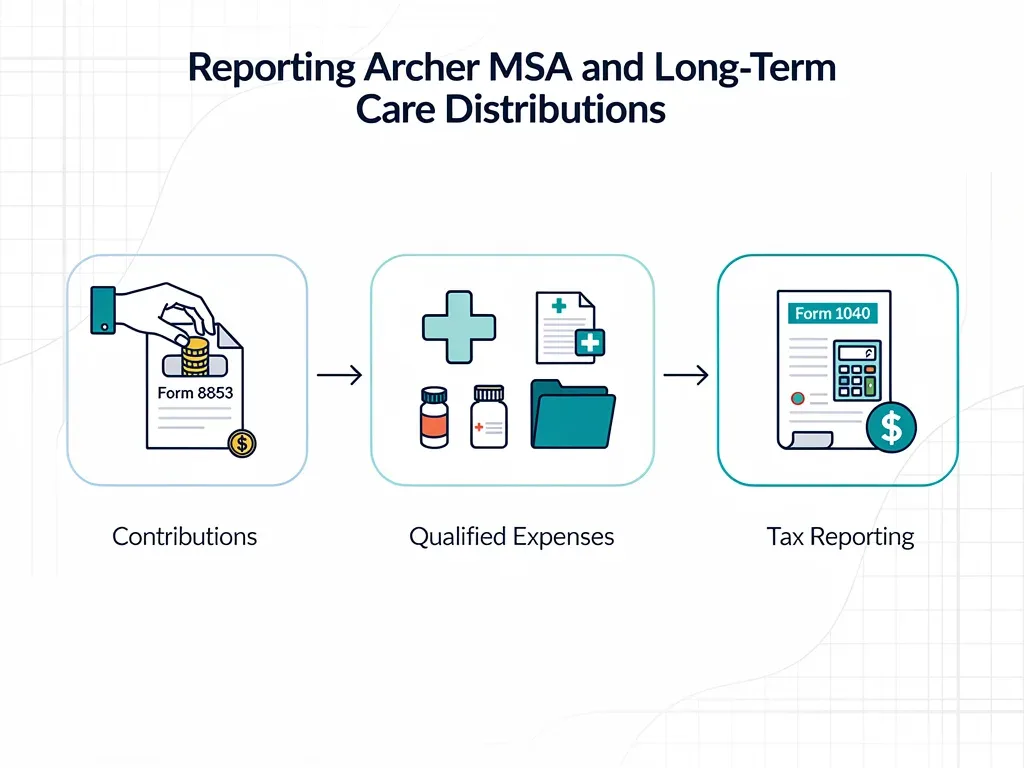
The form distinguishes Archer MSA contributions from withdrawals, includes Medicare Advantage MSA reporting, and addresses certain long-term care insurance payments.
The following table summarizes the main responsibilities involved in completing the form accurately.
Key Point | Brief Description |
|---|---|
Archer MSA Distributions | Report Archer MSA contributions and distributions in their respective parts of Section A, distinguishing eligible and taxable amounts. |
Long-Term Care Benefits | Use Section C when applicable to determine the reporting and tax treatment of qualifying periodic benefits and related payments. |
Record Keeping | Maintain account statements, information returns, insurance records, and documentation supporting medical or long-term care expenses. |
Compliance & Deadlines | Attach Form 8853 to the applicable individual tax return and confirm the filing deadline for the relevant tax year. |
Frequently Asked Questions About Form 8853
What is the primary purpose of IRS Form 8853?
Form 8853 reports Archer MSA contributions and deductions, Archer MSA and Medicare Advantage MSA distributions, and certain long-term care insurance payments or accelerated death benefits. It helps determine applicable deductions, taxable amounts, and additional taxes.
Are all Archer MSA distributions tax-free?
No. Distributions used for qualified medical expenses generally receive tax-free treatment when applicable requirements are met. Nonqualified distributions may be included in income and subject to an additional 20% tax unless an exception applies.
What records do I need to keep for long-term care contracts?
Retain the insurance policy, Form 1099-LTC, payment statements, and documentation of qualified long-term care expenses. Additional records may be needed when benefits are paid periodically or several individuals receive payments relating to the same insured person.
Can I file Form 8853 late?
Form 8853 is generally submitted with the relevant federal income tax return. A taxpayer may qualify for a filing extension, but this generally does not extend the deadline for paying taxes due. Late filing or payment may result in applicable penalties and interest.
What if I made a mistake on a previously filed Form 8853?
If the mistake affects a previously filed federal income tax return, an amended return using Form 1040-X may be appropriate, together with a corrected Form 8853 and required supporting information. Review the IRS amendment instructions or consult a qualified tax professional.
Next Steps for Filing IRS Form 8853
Successful filing of IRS Form 8853 begins with identifying the applicable reporting requirements and gathering documents for the correct tax year.
Review the official form instructions, distinguish contributions from distributions, and verify whether any long-term care payments require additional calculations.
Before submitting your return, confirm all reported amounts and seek professional guidance when circumstances involve unusual transactions, inherited accounts, or complex insurance benefits.