2026 Solar Tax Credit: Step-by-Step Application Walkthrough
Advertisements
The 2026 Solar Tax Credit Application remains relevant for homeowners claiming eligible solar installations completed by December 31, 2025. Recent federal legislation ended the credit for newly completed installations in 2026.
Homeowners who qualified under the previous rules may still claim the 30% Residential Clean Energy Credit when filing their 2025 federal tax returns in 2026.
This guide explains eligibility, documentation, IRS forms, and important deadlines. Understanding the updated rules helps taxpayers avoid claiming credits for installations that no longer qualify.
Understanding the Residential Clean Energy Credit in 2026
The Residential Clean Energy Credit previously allowed eligible homeowners to claim 30% of qualifying solar installation expenses. The program covered qualifying installations completed through December 31, 2025.
Federal legislation enacted in July 2025 accelerated the credit's expiration. Consequently, a 2026 Solar Tax Credit Application generally concerns eligible 2025 installations rather than new projects completed during 2026.
The credit is nonrefundable, meaning it reduces eligible federal income tax liability without creating an additional refund. Unused qualifying credits may generally be carried forward.
Eligibility Requirements for the 2026 Solar Tax Credit Application

Eligibility for the 2026 Solar Tax Credit Application depends primarily on when the qualifying installation was completed. Eligible residential solar systems generally needed to be installed by December 31, 2025.
The property must satisfy applicable residential requirements, and taxpayers must have incurred qualifying expenses. Different rules may apply to primary residences, second homes, and certain equipment.
Before preparing a claim, review the official IRS requirements and relevant eligibility criteria. Documentation should establish installation timing, qualifying costs, and the taxpayer's connection to the residence.
Qualified Solar Electric Property Costs
Qualifying solar electric property expenses generally include eligible photovoltaic panels and essential equipment. These components must satisfy the requirements applicable to installations completed before the credit expired.
Original installation labor and certain associated expenses may also qualify. Battery storage systems with capacities of at least three kilowatt-hours were included under the applicable rules.
For a 2026 Solar Tax Credit Application, homeowners should review itemized invoices carefully. Ordinary roofing repairs and unrelated home improvements generally do not qualify.
Qualifying solar panels and photovoltaic equipment.
Eligible inverters, wiring, and mounting components.
Qualifying original installation labor and related costs.
Eligible battery storage systems with at least 3 kWh capacity.
Primary Residence and Ownership Considerations
Residential solar credit eligibility varies according to the equipment and how the property is used. Qualifying solar electric installations may include eligible primary and secondary residences.
Taxpayers generally must pay qualifying expenses for a residence they use. Special considerations apply to jointly occupied homes, rental arrangements, and certain other ownership situations.
Homeowners sharing installation expenses should document their individual contributions. Accurate records help determine how an eligible credit should be reported on federal tax returns.
Gathering Essential Documentation for Your Application
Organized documentation is important when preparing a 2026 Solar Tax Credit Application. Homeowners should retain records demonstrating that the installation was completed within the eligible period.
Invoices, contracts, payment records, and installation certificates can help establish qualifying expenditures. These materials should clearly identify equipment, labor charges, and relevant completion dates.
Additional records may be necessary when claiming previously unused credits. Keeping complete documentation helps taxpayers respond to IRS questions and accurately prepare their returns.
Key Financial Records to Collect
Detailed invoices provide important evidence of eligible solar installation expenses. Homeowners should confirm that invoices separately identify equipment, labor, and other relevant charges.
Payment records help establish the amounts actually incurred. Installation completion documents are especially important because projects completed after December 31, 2025, generally do not qualify.
A complete 2026 Solar Tax Credit Application should rely on accurate, verifiable records. Retaining supporting documentation also simplifies future questions about any unused credit balance.
Itemized invoices from the solar installation company.
Proof of payment, including receipts or bank records.
Installation contracts and warranty documentation.
System specifications and installation completion records.
Understanding IRS Form 5695
IRS Form 5695 is used to calculate qualifying residential energy credits. Taxpayers claiming eligible 2025 solar installations generally complete the appropriate residential clean energy section.
The form requires qualifying expenditure information and applies relevant calculation rules. Homeowners should use the official version associated with the tax year being reported.
For the 2026 Solar Tax Credit Application, the relevant filing generally concerns the 2025 tax year. Previously unused credits may require additional supporting records.
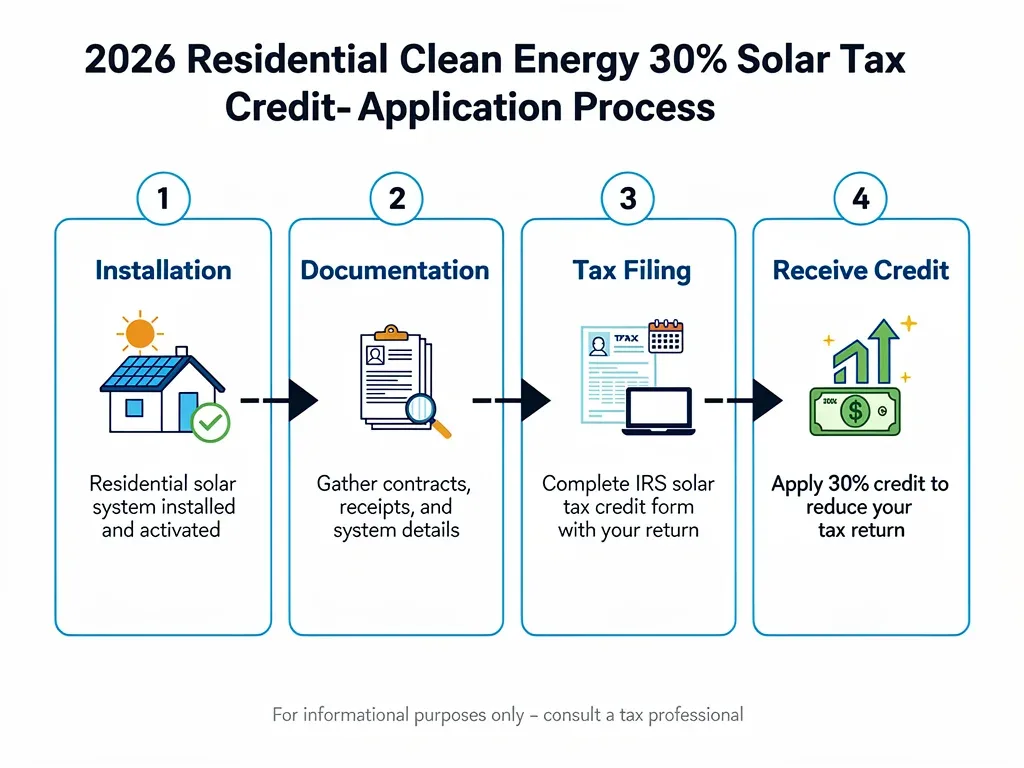
Step-by-Step Application Walkthrough for the 2026 Solar Tax Credit
Preparing a 2026 Solar Tax Credit Application begins with confirming that the installation qualifies under the expiration rules. The original installation generally needed completion by December 31, 2025.
Next, gather invoices, payment documentation, and installation records. Review the expenses carefully to distinguish eligible solar property costs from unrelated home improvements.
Finally, complete the appropriate IRS forms when preparing the applicable federal income tax return. Tax preparation software or professional assistance can help calculate and report eligible credits.
Completing IRS Form 5695
Start with the official IRS Form 5695 and instructions for the appropriate tax year. Locate the section addressing qualified residential clean energy property expenditures.
Enter eligible installation costs using supporting invoices and records. Apply the calculation instructions and any applicable limitations to determine the allowable credit.
The 2026 Solar Tax Credit Application should reflect qualifying 2025 expenditures rather than new installations completed in 2026. Review every entry before submitting the return.
Transferring the Credit to Form 1040
After calculating the allowable credit on Form 5695, taxpayers transfer the appropriate amount through Schedule 3 of Form 1040 according to the applicable instructions.
The credit can reduce eligible federal income tax liability. Because it is nonrefundable, the amount currently usable depends on the taxpayer's circumstances and applicable limitations.
Any qualifying unused portion may generally be carried forward under relevant tax rules. Accurate reporting and recordkeeping help preserve information needed for subsequent returns.
Maximizing Your Solar Tax Credit Benefits
Homeowners preparing a 2026 Solar Tax Credit Application should focus on accurately reporting eligible 2025 expenses. Including legitimate installation costs can help establish the correct credit amount.
Solar equipment, qualifying labor, and eligible storage components may form part of the calculation. Expenditures must satisfy the applicable federal requirements and deadlines.
State and local incentives may also affect the overall financial outcome. Their interaction with federal tax rules depends on the specific program and payment structure.
Combining Federal and State Incentives
Some states and utility providers offer separate solar incentives, rebates, or other financial programs. Availability and eligibility requirements vary significantly by location.
Homeowners should determine whether an incentive affects the federal calculation of qualifying expenses. Different types of rebates and tax credits can receive different treatment.
For a 2026 Solar Tax Credit Application, review both federal guidance and current state requirements. Qualified tax professionals can help evaluate complicated incentive combinations.
State tax credit programs where currently available.
Local utility rebates and eligible incentive programs.
Property tax exemptions for qualifying solar improvements.
Solar Renewable Energy Credit programs where applicable.
Understanding Credit Carryforward Provisions
The Residential Clean Energy Credit is nonrefundable. This means an allowable credit can reduce applicable income tax liability but cannot independently create a refund beyond that liability.
When an eligible credit exceeds the amount usable in the current year, unused qualifying amounts may generally be carried forward under applicable federal rules.
Homeowners should retain previous returns and credit calculations. These records are particularly useful when reporting an eligible carryforward after the program's expiration.
Common Pitfalls and How to Avoid Them
One major risk in a 2026 Solar Tax Credit Application is assuming the 30% federal credit remains available for newly completed residential installations throughout 2026.
Another mistake involves incomplete documentation or incorrectly classifying expenses. Ordinary roofing work, unrelated electrical upgrades, and nonqualifying equipment should not automatically be included.
Using outdated articles or tax instructions can create additional confusion. Homeowners should rely on updated IRS guidance addressing the credit's December 2025 termination.
Incomplete Documentation
Missing invoices, receipts, and installation records can make a solar credit claim difficult to substantiate. Financial records should identify qualifying expenses and relevant dates.
Homeowners should also retain proof of installation completion. A contract signed or deposit paid before the deadline does not establish eligibility when installation finishes afterward.
Maintaining organized documentation strengthens the accuracy of a 2026 Solar Tax Credit Application. It also helps taxpayers respond efficiently to additional information requests.
Misinterpreting Eligible Costs
Not every expense associated with a solar project qualifies for the federal credit. Ordinary roof replacements and structural repairs generally remain excluded from eligible expenditures.
Some specialized solar roofing materials may qualify when they serve as solar electric collectors. Determining eligibility requires reviewing the equipment's actual function and specifications.
Consult the official IRS Form 5695 instructions and residential clean energy guidance. These resources provide more relevant information than unrelated tax publications.
Future Outlook and Tax Credit Expiration
The federal Residential Clean Energy Credit changed significantly following legislation enacted on July 4, 2025. The law accelerated the program's termination to December 31, 2025.
As a result, the former schedule extending the 30% credit through 2032 no longer applies. Homeowners completing new installations in 2026 generally cannot claim this credit.
However, an eligible 2026 Solar Tax Credit Application may still address qualifying 2025 installations. Existing unused credits may also remain relevant under applicable carryforward provisions.
Consulting a Tax Professional for Your Application
The 2026 Solar Tax Credit Application can involve complicated eligibility questions, particularly when installations span multiple years. Professional guidance may help clarify the applicable federal rules.
A qualified tax professional can review completion dates, invoices, and potentially eligible expenses. They can also explain how available credits interact with other tax provisions.
Professional assistance may be especially helpful when taxpayers have unused credits from previous years. Accurate reporting reduces the likelihood of mistakes and unnecessary processing complications.
When Professional Advice Is Recommended
Tax professionals can provide guidance when installation dates or payment arrangements create eligibility uncertainty. Projects involving multiple contracts may require closer examination.
Advice is also useful for homeowners who received state incentives or share property expenses. Different circumstances may affect credit calculations and reporting obligations.
Anyone uncertain about a 2026 Solar Tax Credit Application should seek qualified assistance. This is particularly important when determining whether an installation met the December 2025 deadline.
Solar projects involving multiple installation phases.
Uncertainty about qualifying equipment or expenses.
Interaction with state or local solar incentives.
Unused credits carried forward from previous tax years.
Benefits of Professional Tax Assistance
Professional tax assistance can improve the accuracy of solar credit reporting. Experienced advisers help taxpayers interpret applicable requirements and organize necessary supporting documentation.
They may also identify reporting mistakes before a return is submitted. Proper review is particularly valuable when older incentive rules conflict with newer legislation.
For homeowners managing an eligible 2026 Solar Tax Credit Application, professional guidance can simplify complex calculations. It may also support proper treatment of qualifying credit carryforwards.
Key Point | Brief Description |
|---|---|
Credit Rate | 30% for eligible residential clean energy expenditures completed within the qualifying period ending December 31, 2025. |
Eligibility | Qualifying installations generally needed completion by December 31, 2025. |
Documentation | Retain invoices, payment records, installation dates, and relevant tax forms. |
Carryforward | Unused qualifying credits may generally be carried forward under applicable IRS rules. |
Frequently Asked Questions About the 2026 Solar Tax Credit
What is the 2026 Residential Clean Energy 30% Solar Tax Credit?▼
The Residential Clean Energy Credit previously offered a federal tax credit equal to 30% of qualifying installation costs. The program expired for new installations completed after December 31, 2025. Eligible 2025 installations may still be claimed on federal tax returns filed in 2026.
Who is eligible to claim the 2026 Solar Tax Credit Application?▼
Taxpayers who completed qualifying residential solar installations by December 31, 2025, may be eligible when filing their 2025 federal tax returns. Eligibility depends on qualifying expenses, residential requirements, and applicable IRS rules. New installations completed in 2026 generally do not qualify.
What costs are included in the 2026 Solar Tax Credit Application?▼
Qualifying expenses may include eligible solar panels, inverters, wiring, original installation labor, and qualifying battery storage equipment. Expenses must satisfy the federal requirements applicable to installations completed before the credit expired.
How do I apply for the Residential Clean Energy Credit when filing in 2026?▼
Eligible taxpayers generally complete IRS Form 5695 for the 2025 tax year and report the allowable amount through the appropriate federal income tax schedules. The IRS Form 2441 guide covers a different tax form; for solar credit reporting, consult the official Form 5695 instructions.
Can the 2026 Solar Tax Credit Application be combined with state incentives?▼
Qualifying federal credits for 2025 installations may interact with state or local incentives. Specific rules depend on the incentive structure, eligibility conditions, and applicable tax treatment. New 2026 installations do not become eligible for the expired federal residential credit simply because state incentives remain available.
Looking Ahead: Understanding Your Solar Tax Options
The 2026 Solar Tax Credit Application remains important for homeowners reporting qualifying installations completed during 2025. The federal credit's expiration makes accurate installation dates particularly important.
Taxpayers should use current IRS guidance rather than relying on older descriptions of benefits extending through 2032. Organized records and professional assistance can help clarify eligibility.
Although the federal incentive has ended for new residential installations, state and local programs may offer other opportunities. Homeowners should evaluate current incentives before making future solar investments.